How can I identify authentic Ibérico ham?
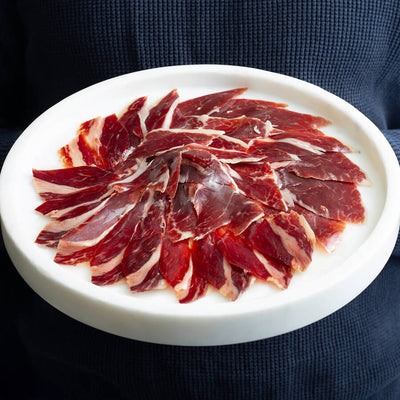
Authentic Ibérico ham can be identified by its official labelling, which confirms the pig’s breed, diet and rearing method. Look for the term Ibérico along with classifications such as de bellota, de cebo de campo or de cebo, which describe what the pigs were fed. Genuine Ibérico ham will also state its Spanish origin and curing period. In appearance, it typically has deep red meat with visible marbling, a sign of the high intramuscular fat that gives Ibérico ham its distinctive flavour and texture.
What are Ibérico pigs?
Ibérico pigs are black pigs with very slender ankles, a long snout to forage and dark skin to protect them from the heat of the sun. The ibérico pig is the result of the cross breeding of a wild boar and a domesticated pig that occurred about 3,000 years ago. The breed has evolved in the south west of the Iberian peninsula since that time, perfectly adapted to the climate, landscape and vegetation of the region, and can live a natural life outdoors all year round.
How should I serve Ibérico ham?
The fat should always be eaten alongside the ham, not cut off or discarded. These hams are best served at room temperature.
Is it normal to see mould on the outside of my ham?
You may see white or grey mould on the outside of your ham. This is natural and occurs as the ham continues to cure. Simply wipe it off with a damp cloth, or trim it away with the skin and yellow fat when carving. This won’t affect the ham’s quality.
What are the different qualities of Ibérico ham available?
All the steps from husbandry to montanera (the fattening period) to cure are variables which influence end quality, and the remarkable flavours which define the best ibérico ham. Ibérico ham is classified according to the purity of the breed, the diet and the production method itself. All hams are labelled with a coloured tag, which indicates the category of Ibérico.
Do all Ibérico pigs have black hooves?
No. There are various sub breeds of Ibérico pig, some without the characteristic black hoof generally associated with the breed. Duroc, the breed allowed to give 50% / 75% Ibérico piglets also has a black hoof. This is helpful to pig breeders as the majority of consumers associate a black hoof with Iberico pigs
What grade is Jamón de Bellota, 75/50% Ibérico ham?
Ibérico ham is classified according to the purity of the breed, the diet and the production method itself. All hams are labelled with a coloured tag, which indicates the category. A red tag indicates a ham made from a free-range, acorn-fed, 75/50% Ibérico pig; Mother 100% pure breed, Father either 50% cross or Duroc.











 2 people
 20 mins