Filter & Sort:

(24 results)

Filter & Sort:

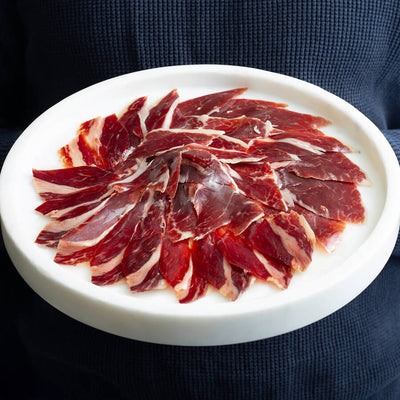
Packaged sliced serrano ham by Luis Gil
Out of stock
Luis Gil Organic Serrano Ham, 100g
Delicate, moist, clean flavour. Pigs graze in La Rioja’s UNESCO Biosphere Reserve. Additive free.  Embutidos Luis Gil crafts organic, artisanal charcuterie from 100% purebred Duroc pigs raised in the Ocón Valley, La Rioja—a UNESCO Biosphere Reserve. The pigs roam freely year-round, feeding on homegrown organic grains, roots, and acorns. This sustainable, closed-loop farming approach ensures exceptional animal welfare, preserves biodiversity, and produces deeply marbled, flavourful meat. Certified organic and free from additives, gluten, lactose, and GMOs, Luis Gil charcuterie offers rich flavour and a leaner profile—ideal for health-conscious food lovers seeking authentic taste and responsible farming.
£9.95
Quick view View
Buy now Buy now
leaf down

FAQs

Spanish ham, known in Spain as jamón, is a cured ham made using traditional methods that involve salting, washing and then air-drying the meat over a long period of time. This careful process preserves the ham and develops its distinctive depth of flavour and aroma.

Spanish ham has been produced for centuries and is deeply rooted in Spain’s cultural and culinary traditions. Originally developed as a way to preserve meat through the winter months, the curing process gradually evolved into a refined craft, with different regions developing their own styles and flavour profiles.

Spanish ham is sought after globally for its exceptional quality, depth of flavour and traditional production methods. From Iberian to Serrano ham, each carries a reputation for excellence that has made Spanish ham a cornerstone of Spanish cuisine internationally.

Spanish ham is first salted to draw out moisture, then washed and slowly dry-aged in controlled conditions. The length of curing varies depending on the type of ham and directly affects flavour, texture and complexity.

Spanish ham is best enjoyed thinly sliced at room temperature. It can be eaten on its own or served with olives, Spanish cheeses and other tapas. It works equally well as part of a sharing board or as an ingredient in simple dishes.

Whole ham legs should be kept in a cool, dry place and covered between uses. Sliced ham should be refrigerated and removed from the fridge shortly before serving to allow flavours to fully develop.

Spanish ham is available both as whole ham legs and ready-sliced packs, depending on how you plan to use it and your level of confidence with carving.

Authentic Ibérico ham can be identified by its official labelling, which confirms the pig’s breed, diet and rearing method. Look for the term Ibérico along with classifications such as de bellota, de cebo de campo or de cebo, which describe what the pigs were fed. Genuine Ibérico ham will also state its Spanish origin and curing period. In appearance, it typically has deep red meat with visible marbling, a sign of the high intramuscular fat that gives Ibérico ham its distinctive flavour and texture.

Jamón Ibérico and Jamón Serrano differ in pig breed, diet, curing time and flavour profile. Jamón Ibérico is made from black Iberian pigs native to the Iberian Peninsula. It is considered the finest Spanish ham and is known for its rich, nutty flavour and melting texture. Jamón Serrano is made from white pigs and is the most widely consumed ham in Spain. It has a delicate, savoury flavour and a firmer texture than Ibérico ham.

The word “bellota” refers to a top grade of ibérico ham that has been fattened on acorns, rather than being solely grain-fed. Bellota pigs are wild roaming over extensive land mass.

The fat should always be eaten alongside the ham, not cut off or discarded. These hams are best served at room temperature.

Ibérico pigs are black pigs with very slender ankles, a long snout to forage and dark skin to protect them from the heat of the sun. The ibérico pig is the result of the cross breeding of a wild boar and a domesticated pig that occurred about 3,000 years ago. The breed has evolved in the south west of the Iberian peninsula since that time, perfectly adapted to the climate, landscape and vegetation of the region, and can live a natural life outdoors all year round.

All the steps from husbandry to montanera (the fattening period) to cure are variables which influence end quality, and the remarkable flavours which define the best ibérico ham. Ibérico ham is classified according to the purity of the breed, the diet and the production method itself. All hams are labelled with a coloured tag, which indicates the category of Ibérico.

Ibérico ham is classified according to the purity of the breed, the diet and the production method itself. All hams are labelled with a coloured tag, which indicates the category. Jamón de bellota 100% Ibérico has a black tag, meaning the ham is from an acorn-fed, pure-bred free-range pig. Mother 100% pure breed, Father 100% pure breed.

Ibérico ham is classified according to the purity of the breed, the diet and the production method itself. All hams are labelled with a coloured tag, which indicates the category. A red tag indicates a ham made from a free-range, acorn-fed, 75/50% Ibérico pig; Mother 100% pure breed, Father either 50% cross or Duroc.

No. There are various sub breeds of Ibérico pig, some without the characteristic black hoof generally associated with the breed. Duroc, the breed allowed to give 50% / 75% Ibérico piglets also has a black hoof. This is helpful to pig breeders as the majority of consumers associate a black hoof with Iberico pigs

No, percentage refers to the purity of the breed of the pig. The 'norma del iberico' allows for a boar to be either 100% Duroc (piglet 50% iberico) or 50% Duroc / 50% Iberico (piglet 75% iberico)

By law, pure-bred acorn fattened animals are a minimum of 14 months old.

Officially, no - only 100% pure-bred, acorn fattened animals can be called 'pata negra' whether the animal in question has black toenails or not!

skewer up