What makes Cantabrian anchovies the best in the world?
Anchovies from the Cantabrian Sea and the Bay of Biscay, off the northern coast of Spain, are arguably the best in the world. They are eaten throughout the country, but particularly in the north, in the Basque Country and Cantabria, where they are fished.
Anchovies are widely eaten and appreciated throughout Spain, France and Italy, but, in the UK, consumers are generally more uncertain about their appeal, though this has been changing.
Brindisa has been importing the highest quality Spanish anchovies, specifically Cantabrian anchovies, for nearly 40 years and bringing them to the attention of chefs and British consumers. The change in their perceptions of these fish over this time has been one of the achievements of which we are most proud.
Why do so many people think they don't like anchovies?
Many people think they don’t like anchovies, but this is a bit unreasonable since it is simply a small, silver fish, engraulis encrasicolus, the European Anchovy. What affects people’s reactions is generally the way in which they are processed and the quality of the processor.
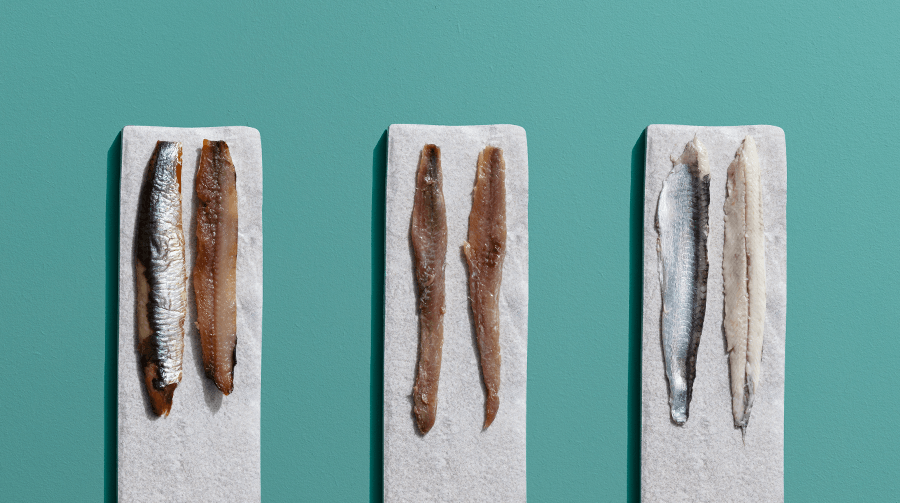
Brindisa sells three distinct styles of anchovy: the salted fillets, the vinegar cured boquerones and the less common brined and smoked anchovy, all made with the same raw material, all very different.
Salted fillets are what most people think of when they hear the word “anchovy”. These are anchovies that have been cured in salt for a period, which dehydrates the flesh, before being filleted and packed.They are generally dense textured, pinkish-brown and with a powerfully salty, fishy flavour. Boquerones are the same fish which have been cured in vinegar before being packed in oil, resulting in a white flesh, bleached by the acidic vinegar - which is moist because the flesh has not been dried by salt and have a mildly acidic flavour. The smoked anchovies are produced from fish which have been brined, rather than salted, and are then smoked; this results in a plump, firm fillet with a gently smoky taste. One type of fish, three very different products.
What's so special about the Cantabrian Sea?
Anchovies have been fished and processed throughout the Mediterranean for several millennia, but it is in the cold, stormy waters of the Atlantic that the best anchovies are to be found. Here, in an environment between the icy waters of the Atlantic Ocean off northern Spain and the more temperate ones off the Bay of Biscay, good oxygenation and low temperatures allow the fish to reach consistent sizes and develop a thicker layer of fat that also benefits the taste.
Toward the end of the 19th century, Sicilian fishermen, whose catches had plummeted in their own Mediterranean fishing grounds, began to arrive in Cantabria and the Basque Country. They arrived at the beginning of the fishing season in March, catching and salting the anchovies before returning, with the fish curing in salt in barrels, to Sicily.
This changed in 1889 when one of the Italian fishermen, Giovanni Vella Scatagliota, married a Cantabrian woman and settled in Santoña, Cantabria, where he built a factory to process anchovies. Where previously in Spain the fish had been simply put into barrels of salt for some months, Scatagliota introduced Sicilian techniques of cleaning, drying and filleting the fish in a systematic way to produce a consistent product. However, where the Italian method preserved the anchovies in butter, he began to use olive oil instead, leading to the production of the anchovy fillet in oil that we are familiar with today.
How are the anchovies caught?
During the fishing season, between April and June, the anchovies feed in large shoals in the shallower waters off the coast, here they are caught in small purse seine nets,: the most sustainable way of catching this sort of shoaling fish with minimal bycatch. They are then landed in the boats’ home ports, where they are immediately sold at quayside auctions called lonjas, to processors, retailers, and restauranteurs.
Who supplies Brindisa's anchovies?
Most of Brindisa's salted anchovies are supplied by Conservas Ortiz, a fifth-generation family business specialising in anchovies and other seafood, with five production facilities along Spain's northern coast. Ortiz sources its fish from carefully selected fishing boats, many of which it has worked with for decades, purchasing the catch directly at the local fish auctions (lonjas) and transporting them to its factories as quickly as possible.
Once there, the anchovies are carefully gutted and cleaned before being layered with sea salt in large curing barrels, each holding several hundred kilos of fish. The barrels are weighted down with heavy concrete blocks, allowing the anchovies to mature slowly and develop their characteristic depth of flavour. After curing, the fish are graded by size. The smallest anchovies are selected for the 47.5g tins, while the medium-sized fillets are reserved for the 78g and 100g formats. The largest anchovies of all are set aside as Ortiz Maestra anchovies. Having spent longer growing in the cold Cantabrian waters, these fish carry more fat, giving them a broader, more succulent texture and a richer, more complex flavour than the standard fillets.
The fish remain in the salt for between 6-12 months, depending on the size of the fish, before they are washed and then filleted by hand, using a small knife rather than the more usual scissors, to produce rich, plump, pink, flavoursome fillets which are then tinned in olive oil. It is this slow salting period that gives the anchovies their intense and complex flavours which have notes of ham and dairy with floral hints as well as the more expected heft of salt and fish.
The anchovies from Conservas Nardín, are also of excellent quality, produced by a family whose members were among the first Sicilian immigrants to the region. Based in the small town of Zumaia in the Basque Country, they buy all their raw materials from the port of Getaria, a mere 6km away, ensuring the freshest possible fish. Their standards are such that, if they are not happy with the quality of anchovies available at the auction, they won’t buy any fish rather than process ones that don’t reach the quality they require.
In Sudi Piggott's Consider the Anchovy, Monika looks back on the moment Ortiz's anchovies changed everything:
Monika remembers, "We both loved the jaunty, distinctive yellow, red and blue packaging of Ortiz anchovies. And tasting the Ortiz anchovies was life changing! It made me realise I had previously only ever experienced quite horrid anchovies. Trully, I had had no idea how they should and could really taste. I was staggered by the quality and flavour."
‘Consider the Anchovy by Sudi Pigott is out now (Headline Home £20)’
How do you eat your anchovies?
The best anchovies are a pleasure to eat in the simplest of ways, but they are also a versatile, umami-rich delicacy which can bring an expansive depth of flavour to other foods.
One of the simplest yet most delicious ways of eating the fillets is simply on pan con tomate, where the two umami-rich components, fish and tomato, combine to create a wonderful sweet, sharp, salty, rich mouthful, lubricated by good-quality extra virgin olive oil. Equally good is the combination of salted fillet and white anchovy, known as el matrimonio, in which the saltiness and sharpness of two different anchovies balance beautifully.
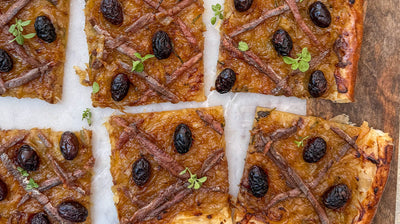
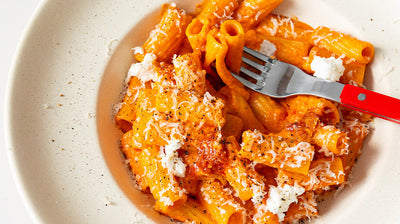
Anchovies pair excellently with pasta such as puttanesca, they bring intensity to a Caesar Salad, they highlight the savoury meaty flavours of roast lamb and make for delicious dips with fresh herbs such as bagna cauda or anchoïade.
We encourage you to overcome any prejudices and give anchovies a try! Forget the low-quality, salty fillets that are often people’s introduction to the anchovy and enjoy the rich, savoury, satisfying fishiness of a high-quality Cantabrian anchovy.












 2 people
 20 mins