Whenever anyone asks my advice about choosing and buying vinegars, my top tip is always to buy from someone who you know cares about it. Then you can be confident of getting a good, well made, delicious vinegar. For me, that makes Brindisa an easy vinegar win. I know that every vinegar on the Brindisa shelves has been chosen with skill and care, and has a story behind its provenance and production that makes a difference to the deliciousness in the bottle.
Making the choice
The first thing I look at with any new vinegar is the percentage marked on the bottle. It’s a bit like when you’re buying wine and the percentage tells you how boozy it’s going to be. With vinegar it’s not about alcohol content, but acidity. Anything less than 5% is too mild a vinegar to be useful in the kitchen. I’m looking for 6-7%, nudging up to 8% for sherry vinegar.
The two big things that distinguish a properly good vinegar from a mediocre one are always: how it’s made and the ingredients.
-
How it’s made: A vinegar maker who has put skill and time into making a vinegar will be proud to say so on the bottle. Look for the words Orleans or Schützenbach – they’ll tell you it’s been made in a traditional, artisanal way that lets the vinegar’s flavours develop. Aging is another clue – anyone who has gone to the trouble of aging a vinegar cares about its flavour. Look for ones aged in wood casks for extra depth.
Another really helpful clue the bottle might have is the marking of the EU’s PDO (Protected Designation of Origin) status. Only 5 vinegar styles in Europe have it, and 3 of those are in Spain (the other 2 are Italy’s balsamics). PDO tells you the vinegar has been made in a way that guarantees its region of origin and production methods. It’s a stamp of standards.
I think there’s no doubt we’re in a vinegar revival. It started a few years ago with chefs using more and more interesting vinegars, or making their own, and has now worked its way into more keen home cooks’ kitchens. So many more people now get – and appreciate – how great vinegar is, and they want to find the really good ones!

Styles of vinegar
For me, the main vinegar styles to look out for are:
-
Wine vinegars: Red, white, rosé. Look for ones that name the grape style or wine region, and then connect whatever you know about those wines to what the vinegar will be like. So for example, a rioja wine vinegar is going to be big and fruity, whereas a champagne vinegar will be light and floral.
-
Grain vinegars: Rice vinegar is the most well-known, with China and Japan having a rich heritage of making and using all the grain vinegars. Their distinctive regional styles are hard to find but worth the hunt, especially when travelling. Rice vinegars tend to be at the milder end of acidity – around 5%. Also: Britian’s malt vinegar heritage is definitely having a revival of production and interest.
-
‘Other’ fruit vinegars, i.e not apple or grape: Wonderful vinegars can be made from raspberries, tomatoes, berries and plums. Look for ones that are a double-fermentation of the fruit.
And that’s the just the tip of the vinegar iceberg! There are wonderful vinegars to be found all over the world but for me – genuinely, I’m not just saying this so the folks at Brindisa will like me more – sherry vinegar is my Desert Island vinegar. It’s the one I wouldn’t be without and that I always urge any food lover to make sure they have at home.
Sherry vinegar's acidity, flavour and depth sit between red wine vinegar and balsamic vinegars. Sherry vinegar starts with sherry wine – which is already pretty fabulous. That sherry is typically, and most traditionally, turned into vinegar by bacteria that sit on the surface of the sherry in barrels that are about two-thirds full. The sherry vinegar then moves through a system of tiers of barrels to become aged and blended. It’s a little similar to the barrel system used by traditional balsamic, and in sherry vinegar is called ‘Criaderas y solera’ – often just referred to as Solera. That’s the word to look for on the bottle.
My top Brindisa vinegar favourites
I am never without any (often all) of the Valdespino sherry vinegars. All 3 of its styles are made in the traditional solera style. There’s:
-
Superior Sherry Vinegar DOP: A rich, nutty, yeasty, complex and deeply flavoured vinegar that’s been aged for 3 years. Really useful for all kinds of meat dishes, soups, marinades.
-
Sherry Vinegar with PX: The difference here is that the barrels used for aging have previously contained Pedro Ximenez sherries. That gives the sherry vinegar an extra mellow and rich character. This vinegar has a deep mahogany colour; with a smell and taste of rich wood and PX notes. It’s the perfect accompaniment for salads, fish and game.
Unico Aged Balsamic PX Vinegar
This one is made from Pedro Ximenex grapes and wine, so has sweetness already built in, plus the word ‘balsamic’ tells me it has reduced, raisined PX grapes added for extra sweetness. It’s such a delicious vinegar with aromas of dried figs, raisins and plums and you really get the aging in American oak barrels in the smell too. Its depth and sweetness make this one well suited to use as a finishing touch. Pour a little over griddled langoustines, soups (especially gazpacho or ajo blanco), ice creams, roasted fruits, or Spanish cheeses. It is also perfect to bring a little sweetness to sharp or salty dishes or simply used in making a vinaigrette.
Unico Fino Balsamic Vinegar
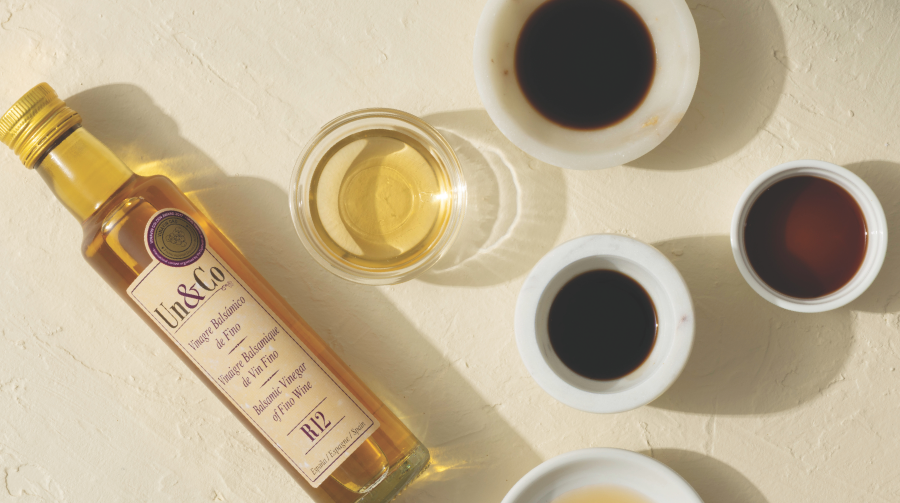
Fino is the driest and the crispest of the sherry wines. Making, therefore, for a dry and crisp sherry vinegar, yes? Well, yes, except this clever producer has decided to swerve away from the expected and add in reduced grape must for sweetness (that’s the balsamic element). That’s a high wire act of vinegar creativity that requires excellent balance of the two opposing aspects for their respective characteristics to complement not clash. This vinegar manages that brilliantly. It’s elegantly acidic with an edge of sweetness. My new fave for quick-pickling slices of apple, for anything with crab or other shellfish, and as an exceptional salad dressing.
Chardonnay always makes for a fruity, crisp, floral & light vinegar. Excellent for fish, seafood, poultry, salads. Use in any dish with mango or apples, or over roasted peaches. Reduce it down when deglazing a pan or simply bubble briefly in a pan to reduce – doing that brings out its fresher fruit flavours and ups the level of sweetness.
![]() Forum Chardonnay vinegar
Forum Chardonnay vinegar
A single-varietal chardonnay wine vinegar with added balsamic-style grape must for sweetness, and aged in wooden barrels for depth of flavour. Also, it’s unfiltered which really allows the varietal flavours to shine. The aroma is complex with citrus, tropical fruits, the crispness of apples and pears and then underneath the fruits are earthier notes of honey, butter, vanilla and hazelnut. I love using this as a finishing drizzle over cured salmon or scallops, or try a few drops inside a shucked oyster. It’s so sweet and tangy and full bodied, it doesn't even need mixing with olive oil for a salad dressing – just drizzle it straight onto green leaves or a tomato salad.
Forum Cabernet Sauvignon vinegar
Another single varietal wine vinegar with added balsamic style grape must for sweetness, and aged in wooden barrels for depth of flavour. It smells of aged wine, coffee and chocolate with spicy, plummy overtones. Those aromas carry through to the flavour, which has a gorgeous balance of soft bitterness and delicate sweetness. I love this. Try it as a finishing drizzle over tuna carpaccio and sardines, or serve alongside Spanish cured hams. Also fabulous in rich pulse dishes or to lift heavier meat dishes like braised pig’s cheeks or beef stews.
This cider vinegar was a total revelation to me when I first tried it! It is so different to so many cider vinegars – not least because it actually tastes of apples! It is made in a traditional style in the very special cider region of Asturias in the north of Spain. It’s a delicious and versatile vinegar that’s perfect for pickles, fish and all kind of salads. Try mixing it with carbonated water for a quick, healthy and really refreshing drink. It is my go-to choice for making drinking vinegar shrubs.
With all these vinegars – and any good vinegars – my advice for storing them is to keep the cap tightly sealed and ideally stored in a cupboard away from direct light. Don’t worry if your vinegar starts to get a sediment in the bottom – that’s just the vinegar ‘mother’ doing her thing. A vinegar won’t go 'off' as such (it is its own preservative) but flavour and colour can change once there is air in the bottle. My best advice is to open it, use it, love it.












 2 people
 20 mins